Don't miss our holiday offer - up to 50% OFF!

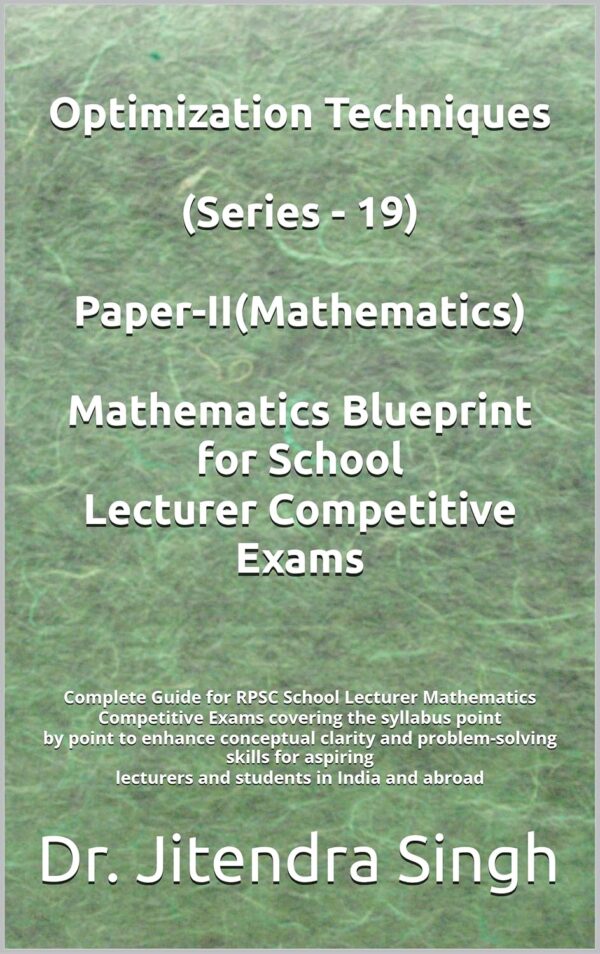
Optimization Techniques (Series – 19): Complete Guide ...
₹1123
Price: $12.50 - $1.99
(as of Jan 09, 2026 20:36:07 UTC – Details)
Optimization Techniques (Series – 19): Complete Guide for RPSC School Lecturer Mathematics Competitive Exams
In the realm of competitive examinations, particularly for the RPSC School Lecturer position in Mathematics, proficiency in optimization techniques is crucial. Optimization is a fundamental area of mathematics that focuses on finding the best solution from a set of feasible solutions. This article serves as a comprehensive guide to understanding and applying optimization techniques, equipping candidates with the knowledge necessary to excel in their exams.
Understanding Optimization
Optimization involves maximizing or minimizing a function by systematically choosing input values from within an allowed set. In mathematical terms, we often deal with functions that can be represented as:
[ f(x) ]
Where ( f ) is the objective function, and ( x ) represents the variables over which we want to optimize.
Types of Optimization Problems
-
Linear Optimization: Involves linear objective functions and constraints. These problems can be solved using methods like the Simplex algorithm.
-
Non-Linear Optimization: Deals with at least one non-linear component in the objective function or constraints. Techniques such as the Lagrange multiplier method are commonly used.
-
Integer Optimization: Involves problems where some or all variables are restricted to integer values, often encountered in resource allocation and scheduling.
- Dynamic Programming: A method used for solving complex problems by breaking them down into simpler subproblems. It is particularly useful in optimization problems with overlapping subproblems and optimal substructure.
Key Techniques in Optimization
1. Graphical Method
For linear optimization problems with two variables, the graphical method provides a visual representation. It involves plotting the constraints and identifying the feasible region. The optimal solution lies at one of the vertices of this region.
2. Simplex Method
The Simplex method is a widely used algorithm for linear programming. It iteratively moves along the edges of the feasible region to find the optimal vertex. Understanding the tableau format and pivot operations is essential for mastering this technique.
3. Lagrange Multipliers
In non-linear optimization, Lagrange multipliers are employed to find the maxima and minima of a function subject to equality constraints. This technique transforms a constrained problem into an unconstrained one by introducing new variables (multipliers).
4. KKT Conditions
The Karush-Kuhn-Tucker (KKT) conditions are necessary for optimality in non-linear programming problems with inequality constraints. Familiarity with the KKT conditions is crucial for advanced optimization problems.
5. Gradient Descent
Gradient descent is an iterative optimization algorithm used primarily in machine learning and statistics. It minimizes a function by moving in the direction of the steepest descent, defined by the negative of the gradient.
Applications of Optimization in Education
In the context of school mathematics, optimization techniques have practical applications in:
- Resource Allocation: Distributing limited resources among competing activities to maximize efficiency.
- Scheduling: Creating timetables that optimize the use of time and resources, such as classroom space and instructor availability.
- Cost Minimization: Finding the least cost for production or service delivery while meeting constraints.
Preparing for the RPSC School Lecturer Mathematics Exam
To excel in the optimization portion of the RPSC School Lecturer Mathematics exam, candidates should:
- Understand Concepts Thoroughly: Grasp the fundamental principles of each optimization technique.
- Practice Problems: Solve a variety of problems to build confidence and familiarity with different strategies.
- Review Past Papers: Analyze previous examination papers to understand the format and types of questions commonly asked.
- Use Study Resources: Leverage textbooks, online courses, and study groups focused on optimization.
Conclusion
Optimization techniques are integral to solving complex mathematical problems, especially for candidates preparing for the RPSC School Lecturer Mathematics competitive exams. By mastering these techniques, educators can not only enhance their teaching methodologies but also contribute to the academic success of their students. As you prepare for the exam, focus on understanding the various methods, practicing rigorously, and applying these concepts to real-world scenarios in education. With dedication and effective study strategies, success in the RPSC examination is within reach.

Reviews
There are no reviews yet.